Donate

We need your help - DONATE HERE
Want to learn more? Go HERE

Wednesday, November 14, 2012

A Busy Day

Every day is different at Visitation Clinic.  There is no predicting how many people will come to our door, or what our staff will have to deal with.   Some days it will just be routine cases.   The next day we will have multiple crises.  Today was one the busier ones.  As recounted by this report from our administrator, here is just a few of today's cases:
Patients in the cholera center.
- 2 cholera patients from O'rouck (about 15 miles from the the clinic), one of them was in a critical state(unconcious) and is feeling better now after 6 liters of IV fluids L.Ringer donated by Direct Relief...The cholera center was damaged after the hurricane and I got two hygienists to make some improvment in it in order to receive the cholera patients.
- One pregnant woman came early from about 6 miles and delivered a baby at the clinic with the assistance of our tireless doctor and head nurse.
- One man nearby came very early this morning at 2am with a sort of intestinal infection (bacillary dysentery) and was kept on observation after a first care with some medicines and sodium chloride 900mg/100ml donated by Direct Relief
- One man came this morning also with a urinary retention with suspicion of STD. He is also kept on observation ...
 
It is evident that we rely heavily on donations of medicines and supplies from other organizations.  Less obvious is that our biggest expense is just paying our staff's salaries.  Their skill and dedication, combined with your donations,  keep our doors open.  It's easy to donate, just go here.

Saturday, November 3, 2012

Recovering

Road crew at work
After repair
Big hurricanes can remind us how small our planet is and how  sometimes we all share the same burdens.   Right now, from rural Haiti to New York City, people are digging out and trying to recover.   Sometimes the only difference is the tools and resources at hand.   For instance, we weren't able to find anyone with road grading machinery  near our clinic, so we relied on the resources we could find; namely picks, shovels and workers who were eager to earn some money.   As these pictures show, it all worked well.  
Washed out road earlier this week
 

Saturday, October 27, 2012

Sandy III

The storm has passed, the sun has returned. and our solar panels are making power again.   Now the clean up begins and we try to figure out how to repair the road.  Meanwhile our latest email brings these pictures of the mother and baby who waded through the rain and mud yestereday to come for help.   As Killy describes:  "He came with a high fever and signs of respiratory distress...  His mother came with much anxiety and left with hope."

Friday, October 26, 2012

Sandy II

It's still raining in Petite Riviere today, yet people are beginning to dig out of the mud.  Actually, you don't have much choice if you don't have anywhere else to sleep.  In Haiti, if you have a house at all, you  consider yourself fortunate.   If you have a cement floor and metal roof, you are even better off.   And if you ride out a hurricane without being inundated with mud or your roof being blown off, you thank God for your blessings.   Haitians are known for their resilience.   One just wishes that it wasn't tested quite so often. 
Meanwhile, the upper part of Visitation Clinic's road is washed out and impassable for 4-wheel vehicles.  Our latest email brings this: 
"Flooding increase in town and access to the clinic becomes worse. Despite of that, we are open to receive emergency patients and we received this morning a baby of 4 months who was really bad and couldn't breath, we did the best for him and he's feeling better now but we do keep him for a while and will tranfer him later" - Killy


Thursday, October 25, 2012

Sandy

At Visitation Clinic we welcome most guests. But if we had a choice, we would  have politely turned our most recent visitor away.  Her name was Sandy and she came calling with lots of rain and 105 mph winds.   Right now, we don't think we've sustained any major damage, but we don't know about the town.   Here are some excerpts from our administrator's mail:                    "... flooding in the town of the petite riviere, hard rains and wind since yesterday, trees are dug up in the yard of the clinic, the way to the generator is blocked with a tree that fell down, the fence of the cholera center is gone, many employees living in town are victims, they move to other places and leave their own houses as they are flooded."
 
"It's hard to go in town now to get pictures, it's raining and the wind is hard." - Killy
 

Monday, October 1, 2012

Break of the Day

This time of year, sunrise is around 6:00 am at Visitation Clinic.  If you want to catch it, you need not set an alarm - the roosters will happily announce it.  With the right amount of cloud cover, the rising sun can be beautiful and the dark Haitian landscape makes it all the more so.  It can be a good time to try taking some low light pictures.  Usually the solar power batteries have run out of juice during the night and there are no building lights to compete with the sky.  On this day, thankfully, the cholera center was dark and empty too,  with the last case being more than six weeks ago.  So we were fortunate to get this nice photo of the arches at the entrance of Visitation Clinic silhouetted by the palm trees and tropical vegetation.   
 
 
Then we noticed  another remarkable event unfolding.  People were already beginning to arrive at our gates.   Even though the clinic wouldn't open for another two hours, patients were beginning to arrive by foot and motorcycle.  In fact, though, this is  a routine occurance.  So much so that the local town has now installed a solar powered street light just outside our gate.  We are, of course, most greatful.   Undoubtedly, our early-bird patients are even more so.


Tuesday, September 25, 2012

Angel with a mop

 
On any given day, a wide variety of people come to our clinic's doors.  About the only thing that is predictable is that there will be a good number of children.  This is especially true on Tuesdays when we offer free vacinations.  Even parents who are poor and cannot read or write know the importance of this.  For instance this little girl is about five, and her only previous visit was when she was one and came for her shots.  Even today, she was just accompanying her mother for her little brother's vaccination.  She was happy until we asked her name, but this made her afraid that she would get a shot too and she wouldn't tell us.  So we were calling her Moppet because she was fascinated by the mop and rolling bucket; perhaps never seeing one before.  When we

found out her real name, it was surprisingly  appropriate.  Her last name is Cherubin.  Her exact age is unkown, because like many of the poor, there is no record of her actual birthday.  Not that she isn't cared for. Her clean dress and carefully corn-rowed hair speak to that.  And her mother's smile was radiant when we showed her these photos.  But you can tell when children come from the poorer homes - she was barefoot, small for her age and didn't have any plastic barrets in her hair.  So even though she will never have a birthday party, we can help her have a healthy and happy life.  Is there anyone who deserves it more, or less?


Monday, September 24, 2012

Some humor from Haiti ...


We've always wondered what babies are thinking and doing as they wait to see our doctors.   So we engaged some eminent child specialist to study the issue.   What they reported was most surprising.  It seems the children have organized a secret auction that the adults are unaware of.  We didn't believe it either until our specialists shows us proof of shoelaces going for 2 goudes. 
(Sorry, we couldn't resist a light-hearted blog when we saw how happy and healthy some of our babies are.)

Sunday, September 9, 2012

Are we making a difference?

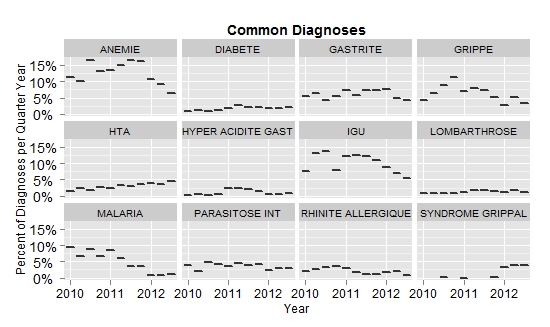
For the last few weeks we've been deep in a dark dungeon known as a computer trying to do some data mining on tens of thousands of patient records.  We wanted to see if we could show whether Visitation Clinic was making a difference in the overall health of our patients.   This can be difficult to ascertain because most people don't come to the clinic unless they are not well.  So we came up with the following scheme.   We looked over the past three years to see what were the top dozen diagnoses and whether they were changing or not.  What we saw is most encouraging.  Some of the most common diseases are trending down.  A few dramatically so.  For instance, the anemia rate is down by 50%, IGU (urinary track infection) is down by more than 50% and malaria has decreased by 90%. 
 
There is actually another piece of important news in this chart.   And that is that we have it.     Visitation Clinic is unusual in that we not only aspire to provide good care.  But we are also committed to putting in place the tools that let us measure how good a job we are doing.  The clinic's records are acquired on a solar powered, networked computer system that we can access remotely and we can monitor daily.   This is incredibly important.  These days smart donors want to know two things:  first that there is a need, second that we will be effective.  The need in rural Haiti is undeniable.  We think we have just as compelling a case for our effectiveness.  

Monday, August 13, 2012


How do we provide low-cost but high-quality care to over a thousand people a month?   Here is a key factor.  Every year we attract a number of new graduates from Haiti's medical or nursing schools.  As a condition of their education, they agree to spend one year in "social service".  This means that they work at a hospital or clinic in an underserved area for a small stipend.  But, the assignments are not made randomly.  Rather, the top graduates get first choice on where they will be assigned.  And in recent years, they've been choosing Visitation Clinic because of our reputation.

This year, we were assigned two doctors and one nurse.  One of our bright and talented young doctors, told us this:   "I was blessed to find Visitation Clinic for my social service work."  It turns out that she faces some of her own health challenges including very strong allergies.  But this hasn't been a problem for her because our cleanliness is so high.  She concluded "I don't think I could have succeeded in my social service work at any other place." 

Wednesday, July 25, 2012

Mothers and Children Report

This past week the last of our summer interns returned home, but they probably have as much work in front of them as their actual internship.  For, we request a formal report to give us guidance on what we should be improving.  We recently received our first report form Dr. Sristi, who returned earlier.  Her report, "Maternal and Child Health at Visitation Clinic", was very well done and gives a glimpse into life in rural Haiti.  Here are some excerpts:

Households:  "Most of the respondents (70.9%) lived in 3-generation families.  These types of families include the respondent and her spouse, their children as well as their parents.  25.5% of respondents lived in nuclear families while 3.6% lived in joint families, where in addition to parents, the household included respondent's brothers and sisters and their respective families." 

Childbirth:  Among 26 women who had recently given birth,  21 delivered at home.  "Among the home deliveries, 90% of them were assisted by midwives, while 10% were un-assisted."

"None of the respondents were aware of the their child's birth weight"

Midwife training:  "The respondents who reported using assistance of the midwives for delivery were asked if they were aware if the midwives had any formal training.  59.4% reported that their midwives were trained, 15.6% reported that their midwives were not trained, and 25% were unsure of the training status of their midwives.  For most midwives who were trained, the place of training was reported as a nearby dispensary."

"Transportation is another major issue faced by the patients as well as the clinic.  Most patients either travel on foot, or use local transportation services like a motorcycle.  The would be a major issue for a patient in labor.  A hospital ambulance service, especially for women in labor would be helpful for the community."

The entire 15-page report is replete with similar insights and facts.   It reminds us that there are still challenging healthcare needs in our community, and it suggests some good ways to respond to them.  For this we are most grateful.  We only hope that our interns know how appreciated there work is.  May they be blessed with the deep sense of satisfaction that comes from a job well done.  


Monday, July 16, 2012

Michaelle's Story

She was 13 when her father brought her to Visitation Clinic.  Michaelle was listless, loosing weight and obviously ill.  Even though her parents were poor and lived in the remote mountains, they had heard good things about our clinic, so they decided to make the journey, even bypassing a much closer health-center.  She was, after all, their oldest daughter and they were desperate not to loose her.  Our doctors quickly diagnosed the problem - diabetes, type I.  Such news is distressing to receive anywhere in the world, but in rural Haiti it is especially foreboding.  Insulin is expensive, hard to find, and there are no refrigerators or electricity to keep it cool.  Plus, patients need a clinic nearby to help them monitor the disease.

Our staff realized the grim predicament that Michaelle and her parents faced.  If she returned to the mountains, there would be little likelihood of controlling the disease, and her young life would be difficult and short.  But people in rural Haiti have a long tradition of sharing burdens and helping each other out.  So a solution was found.  Michaelle would move close to the clinic.  Where would she stay?  One of our own housekeepers volunteered to house her.  What about school?  Our administrators stepped forward and offered to help out.  How about medical expenses?  Visitation Clinic would cover them. 


So, for the past three years, Michaelle has become one of our success stories.  She comes by the clinic every afternoon for her shot and a meal.  In return she helps out with kitchen chores and cleaning.  She is now in fourth grade and is on track to finish primary school next year.  And as the pictures show, her ready smile and sweet disposition are far from the dour little girl who came to our doors three years ago.

Wednesday, July 4, 2012

Sometimes you need a reminder

about why we do what we do.  Recently we received  a pair of emails that did just that.  One was sent by a friend of a Haitian woman, M. who was sick and wound up at the general hospital in Port-au-Prince. 
"It is very tempting to give a play by play of events but in an attempt to be brief -  patients stay for free at the hospital with the idea that they pay for daily examinations and keep up on necessary prescriptions. There is a terrible bathroom provided (I saw it) but no one uses it. Most people have chamber pots next to their cots. Sheets, blankets, pillows and hospital gowns are provided by the patient. M. kept her blood samples on ice in a cooler next to her bed- which was also provided by herself and/or benefactors. Basically if you needed it, you brought it or bought it. When her husband went to talk to the doctor, M. pulled me to her ear and told me that she could not handle being in the hospital any longer. The conditions were terrible and she was afraid of catching something that would kill her while in her vulnerable state. Each cot was about 2 feet apart and in a large room separated only by a nurses station. It resembled a military hospital inasmuch as the density of patients gathered in a single room. Patients were even laying on the ground.... (The hospital doctor)  said that even though he provides care, he is not responsible for anything except for words. He writes prescriptions and does examinations. ...  I inquired about getting M. out of the hospital so that she may live at home until her operation. He agreed and wrote her 2 prescriptions to take home. As we began to gather her things, people started to bicker about who would receive her bed. This caused us to leave in a timely fashion and M. was happy to be gone."

In contrast, the second email was a brief note to our administrator from one of our interns:
"I also wanted to thank you for making my stay at Visitation Clinic very comfortable and pleasant. Your concern for all guests there including me was much appreciated. Your hospitality humbled me. The staff at the clinic was so nice and I appreciate the fact that they went out of their way to make me feel one with everyone else.   ... I was very impressed to see a clinic that provides good health care in rural Haiti. I am sure that the quality of care provided is exceptional and that people are very happy to have the clinic. I sincerely hope that the clinic expands and starts multiple services for people. I see that the work that you do is appreciated in the community and I do hope that continues forever."

Thursday, June 28, 2012

Olympic prep?

On any given day, there is no predicting how many patients will come to Visitation Clinic for help.  Neither can we foretell who the patients will be, or how far they will travel, or what their needs will be.  So our staff is accustomed to the unexpected.  But this past week, we were all surprised to receive a particularly unusual patient with an fractured wrist.  The patient was our own medical director, Dr. JF.  Everyone who knows him recognizes that he is probably the most risk adverse person in VHF.  He is known for his safe driving, for his promotion of preventative medicine and educating the staff and patients about reducing risk and exposure to disease.  And how did he sustain his injury?  Playing football (i.e. soccer).   Now this was not the normal pick-up game of football that one sees all over Haiti on any sized parcel of land, street or alley.  No, this was on our own field with a group of local youths that Dr. JF works with and coaches.  Since formal coaching is rare is rural Haiti, the fact that there is the making of a local team is, in fact, just one more example of how Visitation Clinic is improving life in our area of Haiti. 

Nonetheless, the injury did require surgery this past weekend, and we understand that the procedure was successful.  So we send Dr. JF our condolences and well wishes for a speedy recovery.   And we can't help envisioning a future Haiti where serious disease and other injuries have diminished to such an extent that our major concern will be the occassional sports injury.  Perhaps we can even dream of a future Olympics held in Haiti, centered around Visitation Clinic which has become known as the the thereupitic sports center of the Carribean.  When this time comes, we do hope that everyone will remember that Dr. JF paved the way, even if it wasn't necessarily in the manner that he planned. 

Thursday, June 21, 2012

Trucking


Ever wonder how we get supplies and equipment to the clinic?  Sometimes this isn't an easy task.  There are no routine delivery services like FedEx or UPS.  There isn't even any mail delivery in rural Haiti.  So when equipment and supplies are shipped from the US on a container, our administrator has to hire someone with a big truck that is willing to drive the 70 miles.  Well, the truck came today with a wide variety of cargo.  It included dental equipment, 600 buckets for water purifiers that will be distributed to families, office supplies and even four tires for our vehicle.  How do we get all this stuff in the first place?  Well, some is donated, but most things we have to buy.  It is only by contributions from generous supporters that we are able to do so.  In appreciation to them, we are posting these photos showing where their money is going.  We also wanted to share the wisdom of our Haitian truck driver below.  In English it is:  "With God, nothing is impossible" 

Monday, June 18, 2012

Quarrelling with Flannery O'Connor

is usually not advised.  But she did claim that good men are hard to find.  We're not convinced.  For instance we do know that this summer three pretty good women have found us and are volunteer interns at Visitation Clinic.  Today we welcomed our latest arrival, Dr. Sristi.  She is a recent MPH graduate from Johns Hopkins University  who also has a medical degree from India where she worked at a rural clinic.  Even though she aspires toward a career working with the world's refugees and displaced persons, she agreed to spend a week at Visitation Clinic assessing the Maternal and Child Health needs in our region.  We are delighted to have her.  We were are also intrigued by the circumstantial way that she found out about us.  It turns out that a professor at Georgia Tech had become aware of our clinic, and also had worked with her husband.  Not only did he make the connections, he even has volunteered to cover the week's costs.  So, Ms. O'Connor, you may have been mistaken. 

Wednesday, June 13, 2012

Planning a Hospital

Ever wonder what all the board members and volunteers are doing in the US to support VHF's mission in Haiti?  Well, currently we are spending a great deal of effort planning our next steps. In particular, we have a very active group that is laboring over the question of how to design and build a cost-effective surgical center that will be more effective and sustainable than the standard hospital.  This is the big challenge in Haiti as well as throughout the developing world.   There are, unfortunately, too many empty hospitals throughout the world that were built but couldn't be sustained.  For instance, a survey of a few large hospitals in Haiti shows that their yearly operating costs can be 2/3 thirds of the initial building costs.   We hope to do much better by not overbuilding and by intelligent design.  Right now we are in the phase of soliciting comments from medical professionals and others who have worked at the clinic this year.  

Thursday, May 31, 2012

Interns

This summer our clinic is honored to host a couple interns, one from Vanderbilt University, the other from Cornell.   Each will be working on a different project related to health care in the region that we serve.   Here is a email from Magdalena, who was born in Haiti:

Today I had an opportunity to go to clinic and meet all the staff and to see
the rooms. It is a busy day at the clinic. I was only 8:30 when there were
already 101 patients waiting to be seen, so everyone is working hard. Wish I
was a doctor already and could help, but alas not quite there yet.

Heather, the intern from Cornell and I visited the market today; lots of
good memories returned to me, especially of the tasty fruits. The people are
very friendly and the view of the mountains and the sea here is splendid!
Looks like this is going to a wonderful summer here.

Be blessed,

Magdalena

Marketday in Petite Rivierre

Monday, May 21, 2012

The Secret

Want to know the secret to success?   First you have to realize that it isn't that secret.  A Haitian farmer knows it as "Piti, piti, wazo fe, nich li".  Japanese call it "Kaizen".  US businesses talk about "continuous improvement".  Sports coaches quote Bill Riley "If you are not getting better, you're getting worse".   Even Ben Franklin expressed it - "Without continual growth, words like success ... have no meaning."   Still it's good to see concrete examples.  Today's email from our administrator brought one:  

"Being concerned about reducing as much as possible the load on the energy power of the clinic, I had discussed with the logistic tech of MSPP ... in order to see how we can change the system of the vaccine refrigerator to propane gas, and that MSPP would provide us those gas. The negotiations and agreement are successful, and last weekend the logistic tech came to change the system of the refrigerator .  ...  Ever since the load of the refrigerator was out of the energy system, the electricity stayed longer and never cut off until now."

Steps like this are the reason we have a reliable supply of vaccines for children.   It will probably also reduce our energy bills, because we have to generate all of our own electricity at the clinic.  And it's just one example of how our staff work to try to constantly make thing better.  

By the way, the Haitian proverb above can be translated as "Little, by little, the bird builds it's nest." 


Wednesday, May 16, 2012

Healing Hearts

Today's email is great example of how technology can have a big impact on medical care in rural Haiti.  These are echo-cardiograms of one of our young patients who might need heart surgery.  Our doctors picked up on the problem using time-proven techniques of just listening to childrens' hearts.  The next step was getting these "Echos"  which today were  scanned into our computer at the clinic and emailed to the US using our satellite Internet system.   We've sent them to a pediatric doctor at Johns Hopkins University, and she will be conferring with some cardiac specialists to help decide the best treatment.  When that step is complete, we will begin the process of getting visas and agreements to get the children to the US for surgery.  Meanwhile, its great to see the first steps going as they should.  None of this would likely have happened before the clinic was built.