Saturday, April 28, 2012
Muddy waters
These five hard-working women are some of our most valued employees. Ordinary you would find them cooking, cleaning or washing something. They are the reason that visitors remark about how impeccable the clinic looks.
But this past week they had other things on their minds - their homes had been flooded by the spring rains. With the cholera bacteria loose in the land, we and they were justifiably worried that they sanitize their houses properly, As our administrator Killy (right) emailed us "the clinic decided to donate some items to them in order to help them in their process of recovering the organization of their houses where all stuffs are spoiled with dirty water. Laundry soaps to wash their clothes&sheets, and hand soap liquids that can be used to wash many other stuffs were donated to those employees this morning before they started to work. Those items were donated to VC by either Direct Relief International(hand soap liquid) or by Doctors of the World Belgium(laundry soap) to which we are addressing our sincere thanks."
Their response? Many smiles and Janitor Yvana Louse was translated as saying, ''This is an excellent gesture to us that proves how much Visitation Clinic cares about its employees welfare, and I'm proud to have been working here since the opening''
Tuesday, April 24, 2012
Can't fool the rain
There is a Haitian proverb that a leaky roof can fool the sun, but it can't fool the rain. It means, of course, that there is a big difference between looking good and actually being effective. Well, this is the rainy season in Haiti and yesterday the storms were heavy and flooding occurred. In most communities people have to fend for themselves in times like this. But our staff at Visitation Clinic don't think that their concerns stop at the clinic's boundaries and they have once again demonstrated how effective they are. Here is the email and photos that our administrator just sent:
The rain of yesterday afternoon caused lots of flooding in Petite Riviere de
Nippes, mostly in Dupuy I and II, Charlier and Laguimond near the Clinic. 7
families near the cemetery are the most vulnerable and need emergency response
to decontaminate their house since water from the cemetery go down to their
house and may cause disease.
Dr JF and I just met with some members of a Civil Protection Crew of PRDN and discussed about what can be done quickly for the 7 families most affected(see attached) and how Visitation Clinic can help them with the disinfecting of their houses.
In my intervention I defined a quick action plan that can be implemented:
1- Set up a representative core committee between them to meet with leaders or institutions for help
2- Draining the water from families victims near the cemetery ( talking to the company Vorb&Fils for help with their bulldozers)
3- Set up an executive crew for the decontamination process with chlorine and cleaning in removing mud from the families house.
4- Proceed with the decontamination(disinfecting) and cleaning before the families can use the houses.
Help from Visitation Clinic:
- Donation a big bucket of chlorine
- Donation of 3 big sprays for pulverization
Dr JF and I just met with some members of a Civil Protection Crew of PRDN and discussed about what can be done quickly for the 7 families most affected(see attached) and how Visitation Clinic can help them with the disinfecting of their houses.
In my intervention I defined a quick action plan that can be implemented:
1- Set up a representative core committee between them to meet with leaders or institutions for help
2- Draining the water from families victims near the cemetery ( talking to the company Vorb&Fils for help with their bulldozers)
3- Set up an executive crew for the decontamination process with chlorine and cleaning in removing mud from the families house.
4- Proceed with the decontamination(disinfecting) and cleaning before the families can use the houses.
Help from Visitation Clinic:
- Donation a big bucket of chlorine
- Donation of 3 big sprays for pulverization

Thursday, April 19, 2012
And the children keep coming
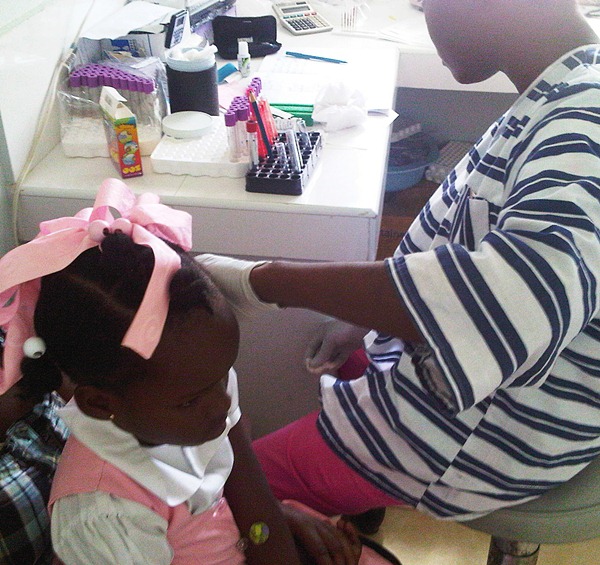
This week we are again hosting a team of pediatric surgeons from Maryland and California who have years of experience working in developing countries. Even though Visitation Clinic doesn't yet have an operating room, the group was previously so impressed by our clinic and staff, that they wanted to use us for everything except the actual surgery. This includes patient screening, lab work, pre-op meetings with the children and parents, and post-op follow up.
Many of the children require ambulatory surgery for a variety of issues including umbilical hernias, hydroceles and undescended testis. In the US, these conditions are common and are treated before children are a year old. But in
Haiti, its a different story and we have a list of over sixty children who need help.
Right now, we are actively planning on adding a surgery and other hospital facilities. You can help us write a new story for rural Haiti by donating here.
Many of the children require ambulatory surgery for a variety of issues including umbilical hernias, hydroceles and undescended testis. In the US, these conditions are common and are treated before children are a year old. But in
Haiti, its a different story and we have a list of over sixty children who need help.
Right now, we are actively planning on adding a surgery and other hospital facilities. You can help us write a new story for rural Haiti by donating here.
Tuesday, April 17, 2012
Deserving
Why do so many volunteers who visit our clinic want to return as soon as they can? For instance, this week we have a group of surgeons who first visited clinic two months ago. Even though they had to raise the funds for travel and supplies, and even though they have to commute for an hour or two to use the operating room in an overcrowded hospital, they wanted to stay at Visitation Clinic. Moreover, they wanted to focus on our region's children who have a long-deferred need for surgery. So the children are making the commute too.
Well, part of the answer is simple enough. Visitors quickly see how deserving and endearing are the young people who live in our part of rural Haiti. For instance, if they need care, they and their families will come to our clinic early, dressed in the their cleanest clothes, and wait patiently for hours to be seen. This photo is a candid picture taken during a recent pediatric dental mission. There were so many children that morning, that were probably quietly waiting for hours when this picture was taken. Later on, we figured out a way to pass out tickets so that they knew when to come back. After all, kids like this deserve a break, and we, and our volunteer visitors, are trying our best to see that they get it.
Saturday, April 14, 2012
After hours
It's hard to describe to people in the US how much difference a well-run clinic can make in the lives of families in Haiti. In so many rural areas of Haiti, medical care is hours away. And late in the day, or on weekends, most clinics are locked and help may not be available at all. At Visitation Clinic it's not unusual to see scenes like this. Even though it is after normal hours, when these worried parents arrived with their daughter, our staff re-opened the clinic to help.
It's also notable, and not unusual at all, that both parents have journeyed with their child to get help. Parents in Haiti will do anything for their children and they work hard trying to earn the money to pay for school tuition, food, or health care. They know that Haiti is changing. They see it in the quick spread of cell-phones, motorbikes, the new road, and in Visitation Clinic. We've been open for over four years now and the community, which has seen other groups come and go, seems to have a new confidence and they are daring to dream of a better live for their kids. You can help make this dream continue by donating here.
Tuesday, April 10, 2012
Video Now Online
We've just posted a high resolution video that pictorially tells the story of Visitation Clinic. You can see it by clicking here or copy the following into your browser address line: http://s833.photobucket.com/albums/zz251/artfj1/?action=view¤t=PS2011_FinalLghtC.mp4
Sunday, March 25, 2012
A long wait
By the time our visiting dentists left they had seen 111 children and 116 adults. Throughout the day people were waiting as shown in this picture. Haiti doesn't have many dentists, only about 350 for its 10 million people. And most of those are clustered in the cities. In comparison, the US has twenty times that number per capita. A good inidication of this is that even our own staff were in need of dental attention and on the the last half-day, after the last patient was seen, our team worked into the night attending to our staff. .
Monday, March 12, 2012
MacGyvering in Haiti
Sounded simple enough. Just ship down a high quality dental compressor and we'll have a dental clinic running in no time. And sure enough, it worked great last year. But, just let a few months go by and it's a different story. Now the compressor doesn't cut off and the pressure keeps building until there's this busted hose flailing around the clinic and hissing like a viper.
What to do? There's probably a manual on it somewhere, but who knows where that got off to. A search of the compressor leads to a cut-off switch that appears to be pressure activated. Remove the cover and what you see is shown in the photo. Everything looks fine, except what is that dirt in the bottom of the switch? A closer look and, what do you know? - some insect has built a mud nest right in the switch. Now what? We certainly don't have a spare switch or a spare compressor. Well, for occasions like this, you call for the trip's MacGyver. Every team needs one. This is the guy who grew on a farm, or runs an excavating company, or who has owned six motorcycles, or was driving a real fire-truck when he was 15. Where do find these four people? Well in our case, it's just one guy who is also an EMT and is doubling as a dental assistant. Sure enough, our MarkGyver takes one look at it, says we've got to take the whole thing apart, does so, cleans out the pressure gasket, fixes the blown hose and in twenty minutes we're good to go.
It reminds me of a conversation I had once with a hospital administrator in Haiti. He said, "You know, I can get all the volunteer doctors, nurses, and medical people I want. They're all such good people and think nothing of volunteering in Haiti. But, do you know who I have the hardest time getting and is worth his weight in Prestige beer? - a good diesel mechanic." Or, in our case, a good MacGyver.
Saturday, March 10, 2012
Dentists in Action
Since we teased our dentists in the previous blog, it time to make things right and show the reality of how hard the team works when they come to the clinic. Here is short clip of what it takes for two dentists to work in one un-airconditioned room in Haiti, with the help of assistants and an interpreter. Dr. Betsy (on the left of the room) has a real dental chair with all the equipment to do restorative dental work. She mainly sees children 14 years and younger. On the right of the room is Dr. Larkin, who is working on adults, most of whom need to have extractions. Assisting is Stacy and Mark, along with interpreter Johnson. They all start early and don't quit until the sun has set. They've had to deal with intermittent electricity, a shortage of supplies because most are still on a shipping container in Port-au-Prince, and even patients with extraordinarily high blood-pressure. In the first three days they saw 82 patients, many of whom needed work on multiple abcessed teeth. Out in the hallway are just a few of the patients waiting to be seen. Most of the patients are on the back porch.
Friday, March 9, 2012
Toys for teeth
Wednesday, March 7, 2012
Typical patients
Who are our typical patients? This photo may capture it best. Last year 50% of our patients were women and 27% were children. If you further divide our patients into two-year increments, the largest single age group are babies from 0 - 2 years old. They made up 11% of our patient-encounters last year. The second most common age group was 22 to 24 years old mothers.
Thursday, February 16, 2012
Tents Arising
This week we have welcomed a visiting team from Knoxville, TN. This is probably the most diverse group of visitors we've had this year, for not only do we have medical professionals, but we've also got an agricultural and seed expert, two high school students, and a couple all around McGyvers. One task they tackled today was erecting a large surplus tent that we acquired as part of our disaster and emergency readiness plans. From the pictures, it appears that it takes a village to set up the thing, but now it is erected we hope to use it for family shelter for a pediatric surgery effort we are currently planning. Monday, February 13, 2012
Farewell New Jersey
Our team from NJ left as they began, "organized to a T" and with time scheduled for a group photo in front of the clinic. They wanted to spend a lot of time with our interns and we're told the interactions were well worth it. They also saw, first hand, how our clinic encounters cases that are more typical of hospital emergency rooms in the US. This past week was no exception as they dealt with cases ranging from extreme diabetis to trauma care. Also, we were delighted that they even followed up with a lengthy report of their visit. This included such a detailed survey that it noted that in a particular hallway, the paint was a mix of flat and gloss and perhaps should be redone. All we can say is that even though it took a countrywide search, we've finally found a group who cares as much as we do that everything be perfect. Hurry back New Jersey.
Thursday, February 9, 2012
Haitians helping Haitians
This week's medical team is notable in that two of its members were born and trained in Haiti, but also trained in the US and are now returning as volunteers. Dr. Andre-Jean is a pathologist who works in family practice in the US. Here he is shown caring for a mother and her baby at Visitation Clinic.
Below is Ms. Raymonde - a pharmacist and, we're told, an artist. She is helping to organize the clinic's pharmacy using some of the principles common in US pharmacies. Clear labeling and organizing meds by use can be an important way to make a pharmacy more efficient and safer.
Monday, February 6, 2012
New Jersey Medical Group
This week Visitation Clinic welcomes our second group of new visitors. It is lead by Dr. Sue from New Jersey who is a pediatrician and also a specialist in adult asthma and infectious diseases. She emailed last evening: "We got to Visitation Hospital at 7 pm.had a good dinner. Giants won!!! I'm in heaven." We mention this, not to offend any of our Patriot supporters (bless them all), but to highlight the fact that our hospitality includes good food, fine rooms and, notably, satellite Internet that keeps everyone connected to the world's important events.
The group consists of two pediatricians, an internal medicine specialist, a pathologist and a pharmacist. Shown here are our pediatricians Dr. Sue and Dr. Harriet,
Thursday, January 26, 2012
Happiness is ...
Yesterday morning Frantz T., age 7 came to the clinic with lots of smiles. Last week he had surgery to have an umbilical hernia repaired and returned to have his bandage removed and a check up. His mother told us ''I'm very happy that Visitation Clinic with the help of the Americans realized the surgery for my child, I did not like his big belly and I was not able to afford the surgery in Port-au-Prince. '' Even minor surgeries like this can have a big impact on a child's well being and how they are treated by their friends and the community. Our visiting Mercy Medical Care team performed 15 procedures last week. They also identified another 60 children who need surgery, some of it major. We are working with them to schedule a return in April. We are also developing plans for a clinic expansion to accommodate more frequent surgical teams. There is an acute shortage of hospitals and clinics with surgical capacity in Haiti. Your support HERE can help us fix this.
Wednesday, January 25, 2012
Maryland Team - Last Day
On the last day of the mobile clinic, the team hiked up the mountains to visit the town of Sillegue. This is one of Haiti's many isolated villages that have little access to medical care unless they walk several hours to a clinic such as ours.
Children attend the open air school (right) which became the clinic for the day. The mobile team saw about 150 children and babies. They treated more cases of scabies and identified three more children who require surgery.
Friday, January 20, 2012
Maryland Team: Days 3 & 4.
Hosting visiting medical teams is one of the many services that Visitation Clinic brings to rural Haiti. These teams can provide the resources to stage mobile clinics in schools and distant villages. These mobile teams can provide general heath screening for a good many people and identify those who need care at the main clinic. This week, the team from Maryland has done this exceedingly well. Here is what Dr. Karen emailed us today:All is going well...
Thus far we have eval approx 1700 children in 6 schools ...today the team is going to a far away village...taking the bus part way and then hiking the rest...expected to be a 90 min walk ...they are excited!
Meanwhile, the surgical part of their team has completed 11 operations, with another five scheduled for today. This week they have had to perform these surgeries at an overcrowded and poorly equipped government hospital located in the nearest city. Because of these conditions, there are another fifty children who need surgery, but won't be helped. Next year, we are hoping, will be quite different. We hope to have made some modifications to our clinic that will allow for basic surgeries. You can support this effort by donating HERE
Tuesday, January 17, 2012
Maryland Team: Day 2
Today our volunteer medical team visited two more schools and screened another 700 students. A common disease that they are finding and treating is a skin rash known as scabies that is spread by a small mite. About 10% of the children have this. More serious is that a few children in each school need surgical intervention for conditions ranging from hernias to heart problems. Fortunately, the visiting team has a pediatric surgeon with them and they are attempting to treat some of these children in a nearby hospital. This is difficult for many reasons ranging from the lack of space and resources to bureaucratic issues. Nonetheless, today they were able to treat two children today who needed minor surgery (photo below).
Monday, January 16, 2012
Maryland Medical Team
This week the clinic is honored to host a large medical team who are associated with Johns Hopkins University and the Mercy Medical Mission. Lead by Dr./Sr. Karen Schneider, a pediatrician at Johns Hopkins University Hospital and a Sister of Mercy, the group will be focusing on the children that live in the region served by Visitation Clinic. They arrived late Sunday afternoon and wasted no time getting to work. On Monday evening Dr. Karen sent us this email.
"Today we went to C.E.S.A and saw 740 primary school children. We found 20 who need surgery that we can do this week and the teachers are trying to get the message to the families. We found 2 with bad hearts and 1 who has knocked knees and needs orthopedic surgery. Dr JF told me about 5 other children with heart problems and I am working on getting them to USA for surgery."
Subscribe to:
Posts (Atom)