Donate

We need your help - DONATE HERE
Want to learn more? Go HERE

Thursday, April 28, 2011

Watchin'

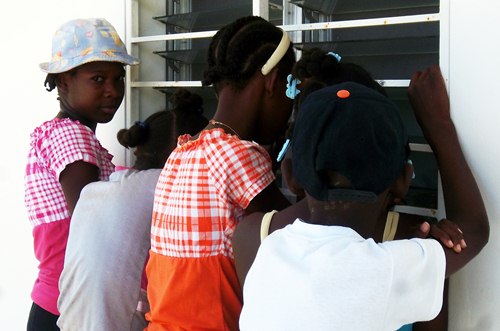
Our dental team has treated 121 patients as of yesterday, and somehow they are able to see more each day.  Yesterday they saw 30 children, nine of whom were under six years old.  As seen here, there is often an audience of very interested children at the window who seem riveted by watching our dental team at work.  Dr. Betsy encourages this.  She hopes the onlookers today will become the future dentists of Haiti.  We also want to note that the newest member of the Unit is Mr. Johnson (left).  He is an interpreter who lives in Petite Riviere when he is not in school.  He has become our dental health advocate who explains to the children the technique and importance of taking care of their teeth.

Wednesday, April 27, 2011

Waitin'

 
Waiting for the dentist
 
Waiting some more


\

Still waiting


Monday, April 25, 2011

Redemption songs


\

Rural Haitians have little exposure to video media.   Televisions are scarce, theatres are rare, and even the viewing of DVDs is limited.  What takes their place are the churches.  Even a small town like Petite Riviere can have a grand church that holds a large congregation, some of whom will walk considerable distances to attend.  Non-Haitian visitors to rural churches are infrequent, but those few who are fortunate to attend will invariably experience an unforgettable celebration.  Perhaps most striking is the music.  Even on Sundays in ordinary time, the celebrations will seldom last less than two hours and the musical bounty that enfolds a visitor seems to endure and refresh for days.  The entire congregation is the choir and all will sway and pray, both individually and communally in harmony to the music.  The instrumental accompaniment is just as diverse and infectious.  Drums, of course, are prominent and essential.   
This past Sunday was Easter and the ceremony was undoubtedly the most spectacular of the year.  But even the days preceding Easter have their own beauty.  For instance, the music and lower photo here came from the more reflective celebration on Holy Thursday. 
This past year, the world has noted the tremendous resilience and hope that Haitians retain, even in the most trying of times.  One cannot help but wonder if it is Haiti's music and celebrations that nourish this most precious of virtues. 

Saturday, April 23, 2011

The Unit

There is a television series called "The Unit" which is about a team of specially recruited, highly trained, disciplined and dedicated soldiers who work in difficult circumstances to accomplish their mission.  I dream that the producers will travel to rural Haiti someday and see the real thing at work.  We have a number of Units at Visitation Clinic.  Our newest one is lead by Dr. Betsy Barcroft from Memphis who is an accomplished pediatric dentist and spends her free time treating disadvantaged children to places like Alaska, Hopi Indian reservations, rural Arkansas and now Haiti.  She and her incredibly efficient assistant Stacy have volunteered for ten days to work at our clinic with the goal of seeing every child they possibly can.  Each day, they start early, don't want to take lunch breaks and work until the last child is seen.  They spent weeks preparing for the trip, acquiring all the equipment, supplies and instruments, which they squeezed into their checked baggage.  Betsy even did her own fundraising for the project.  

It is unfortunate that our Unit's members share a major flaw which will keep them from becoming television action heroes.  They are just too darn nice to be believable and the children actually like them.


Wednesday, April 20, 2011

The worst of times, the best of times

Imagine for a moment that you are a child in rural Haiti and your tooth hurts.  Next thing you know your parents are taking you to a big white building where maybe you can hear some kid crying through one of the windows.  Then after waiting for a long time, your mom takes you to a  room filled with scary stuff, where these pale strangers put you into a weird chair that nearly turns you upside down, then they get out the biggest needle you've ever seen, even though they try to hide it, and then it feels like a couple stings and your mouth feels thick and funny.  Next thing they are cramming  weird gadgets that look like scissors into your mouth, then a loud machine makes this noise and there is a whining sound on that tooth that you don't want anyone touching.  And you can't even holler to your mom who is sitting next you looking worried.  Finally after a fistful of forevers they are taking the stuff out of your mouth and you can't stop shaking and you want to cry except it seems too late.  But then the strangest thing happens.  You get this little car like you've never seen before with wheels that actually turn and it's the most wonderful thing and you can't wait to get outside to play with it.  And somehow you can't quite remember how the worst day of your life turned into one of the best.

Click here and you help change a child's day at Visitation Clinic in Haiti.


Tuesday, April 19, 2011

Dental screening

This week we are bringing a new program to Petite Riviere - pediatric denistry.  We have two dedicated volunteers with years of experience in chilren's denistry.  Today they were screening children in a nearby school.  The video shows how this was done.  Unfortunately our team found that nearly all of the older children had untreated cavities and other dental problems.  In fact, it looked like most of children had no prior dental care.  Over the next ten days, our team will be treating these children and, we hope, many others too.  Our team won't be pulling many teeth.  They have come with all the equipment and materials to do high quality restorative dentistry.
If you are very observant, you can see on the blackboard a table showing the size of the class.  For those of you who can't quite make it out, the sign shows that there are 83 children in this modest sized class room. 

Saturday, April 9, 2011

Market

In rural Haiti there are no supermarkets, convenience stores, or Walmarts.  Shopping and trading is done in an open market that lines the main street of Petite Riviere every Wednesday. 
The daily diet of most rural Haitians consists of rice, beans, fruit and grain products.  With no electricity, there are few refrigerators and ice is a rarity.  So storing meats and fish is a challenge. 

The lack of refrigerators also impacts the healthcare that Visitation Clinic provides.  We can't dispense pharmauciticals that require temperature controls.  And patients with trauma injuries can't apply ice to reduce swelling.

Saturday, April 2, 2011

Education

One of VHF's core missions is to provide health education to the general populace.  We do this in a variety of ways, including radio talk shows, large public gatherings and, every morning, a meeting with the patients.  These photos show typcial morning meetings.  The patients have gathered in the clinic's shaded portico and are waiting for the clinic to open.  Each day, one of our medical staff has been assigned the task of preparing a short talk on some public health issue.  This can range from basic hygiene, to child nuitrition, to the need to take medicines in the proper manner.  When Dr. JF is the presenter, there is often much humor in the presentation and much laughter and smiles in the audience.  Programs like this can be one of the most effective ways to improve overall health, as well as to quickly get on top of outbreaks of diseases like cholera.

Monday, March 28, 2011

Artists

One wonders at times if there is a more naturally artistic people than Haitians.  From the infectious music, to the elaborate painting of the private buses or "tap-taps" one can hardly avoid encountering artisans.  Even in rural areas like Petite Riviere, one can encounter art in surprising ways, including the elaborate embroidery of children's homemade dresses and the painting of fishing boats. 
Still, we were surprised on our recent trip to find this elaborate mural on the walls of a new gathering-spot that is being built.  The artist is a local resident who appears to have not just exceptional skill but a great deal of practice and training.   

Friday, March 25, 2011

Homes of Petite Riviere

People wonder about where our patients live and what a typical home looks like.  Here are two that sit on the beach.  Houses are made of either wood or cement block with a metal roof.  They are about the size of the utility sheds that are sold at places like Home Depot or Lowes.  If the family is very poor, the floor will be dirt and the roof might be banana fronds.  More common will be a concrete floor.  Cooking is done outside the house, usually on the ground and over charcoal.  Indoor plumbing is very rare.  There is no electricity, of course.  Glass windows are only for the rich.  As are window screens.
 
These homes sit right at the sea's edge and in good weather the view is very beautiful.  But, as everyone knows too well, Haiti is prone to earthquakes, tropical storms and huricanes.  Houses like these are not where you would want to be in any of these. 

Monday, March 21, 2011

Smiles

Kids in Petite Riviere don't get their pictures taken very often.  When you attempt this, they are usually so puzzled that it's hard to get them to smile. You can say "souri" (Kreole for "smile") but this normally results in a look of Mona-Lisa bemusement.  For example, check out the photo in the "Shared Bond" blog below. 

But here is a trick that works every time.  You show them their picture on your digital camera. Giggles of delight are always forthcoming.  Of course that doesn't help you get a picture of them smiling, unless there happens to be a real photographer nearby who can capture the moment.

Such is the case here.  Bob Roller of CNS was visiting our clinic when these girls saw, perhaps for the first time, their digital images.  Everyone was delighted. 

You can share in this wonder very easily.  Just click here to donate.

Friday, March 18, 2011

Laundry

Sometimes photos of kids from Petite Rivierre can be misleading.  Like this little girl, they usually are well dressed, clean and cared for.  But close-up photos like this don't show the context of their lives and don't convey the reality of the poverty that many families live in.  For example, very few rural Haitian families have homes with running water, electricity, kitchens or any of the features that many consider essential.  Consequently, many ordinary chores require more work than most of us imagine.  For example, the picture below shows how this mother washes clothers. 
Our clients live in a poverty that one just doesn't see anymore in the US.  This is why our clinic only charges a token amount for the healthcare we provide.  We don't charge for lab tests.  Prescriptions are also free.  So we have to raise well over 90% of the cost of providing this care.  We get help of course.  Groups like Direct Relief International provide us with many of the common pharmauciticals that we dispense.  This helps keep our cost below $20 per patient.  But we treat over 1000 patients per month, so groups like ours are constantly in a fund-raising mode.  Our biggest expense is just paying our Haitian staff's salaries.  We have over 30 employees which makes us the biggest employer in the region.  And even though Haitian medical profesionals make far less than their US peers, their combined cost is substantial.
You can help us sustain this by clicking here.

Wednesday, March 16, 2011

A shared bond

Friends in need
These are two of three little girls whose mothers brought them some distance to be treated at the clinic.  All three have cardiac problems and their mothers by-pass other healthcare facilities for the care and compassion of our staff.  They probably need heart surgery, but this is not something that is obtainable in Haiti. So for now we are treating them with the drug Enalapril, which allows the heart to work more efficiently.  Dr. JF is encouraged by their response to this medicine, and they are doing reasonably well.

Obtaining modern medicines like this is one of the challenges that the clinic continuously faces. At times our administrator spends hours going to various distributors to find the right meds for patients like this.

Typically, children are about one third of our patients.  And typical of most of our children patients, these girls are wearing their very best clothes to come to the clinic.

Tuesday, March 15, 2011

Roads


Arrived in Haiti yesterday.  On drive from the airport we stopped at the Haytrac - Haiti's large Caterpillar dealership.  There we met the owner, Mr. Reymond, who has offered to help us fix our washed-out 1/4 mile access road.  He was most enthusiastic and he re-affirmed his generous offer to help get our road graded and compacted, with a drainage ditch on either side.  It is this drainage that will be the major issue, for without it any improvements will be washed away quickly.  Next we spoke by cellphone (which are transforming the ability to work in rural Haiti) to our Haitian civil engineer and clinic-builder who also offered his help.  He too underscored the need for drainage control, but soberly estimated that it should be lined with cemented-rocks which could cost around $20,000!  Still, we remain hopeful that through the help of these freinds the job will get done.
Work on main road.


The good news is this.  The government work on the main coastal road is progressing nicely.  It is only a mile or so to the point where our access road connects.  When completed this road will improve the access to the clinic enormously.


Thursday, March 10, 2011

Suffer not the children

How does a group know if their efforts are making a difference in Haiti?  Here is one example.  Recently we had an inquiry about setting up a malnutrition program at our clinic.  So we were challenged to estimate the degree of the problem.  Fortunately (and unusually) this is the kind of question we can actually answer rather quickly.  Our clinic has a computer based record system in which we can search patient records and look for diagnoses such as "MALNUTRITION".  We saw that the number of cases had dropped wonderfully in 2010.  Seven cases in the first quarter of the year, three the second quarter, none at all for the rest of the year.  This was a most encouraging result to see, even while granting the seasonal nature of such afflictions.  It challenges us to keep working.  And to even dream of a Haiti where all the children grow up healthy and well.

Tuesday, March 8, 2011

Dine out for Haiti

A few weeks ago our clinic staff celebrated the third anniversary of  our clinic's opening.  It was a festive affair with an elaborate spread of Haitian country cooking. 

Here is your chance to do something similar.  On April 4, Nashville's Amerigo Restaurant is sponsoring a three-course Italian feast, complete with wine, all for the benefit of Visitation Hospital Association.  For just $100 per person you can enjoy a evening of fine dining while knowing that half the proceeds will be going to support healthcare in Haiti,. 
For Reservations, call:
Fran Rajotte
615-673-3501
 
or register online at

Monday, March 7, 2011

Mundane work makes the difference

Making a clinic run well and effectively requires a team of people who pay attention to details.  One of the key components is knowing what you have and where it is.  This can be a big challenge in Haiti where a wide variety of supplies are contributed by visitors and various other suppliers.  If you don't organize it you won't be able to find it in an emergency.  So in recent weekends our two key managers (Dr. JF and Killy) have organized an inventory effort to do just that.  They've even enlisted the help of a pharmaucitial specialist (photo) to help sort things.  It is only by this kind of mundane work that Visitation Clinic achieves it's success.

Thursday, March 3, 2011

Clinic architect gives presentation

AlanDooleyHeadshot1.jpgOne of the exceptional features of Visitation Clinic is it's innovative architecture.  This week our architect, Alan Dooley, gave a presentation at Vanderbilt University titled "The Challenges of Medical Architectural Design in Low Resource Settings and Strategies Employed".  This informative and entertaining presentation can be viewed here.

Alan is a LEEDS certified architect, a member of the VHF's Board and has donated a great deal of time and effort to the design and building of the clinic and it's infrastructure.  It is only through the efforts of volunteers like him that the clinic has been built and sustained.  You can be a supporter too by clicking.HERE

Wednesday, March 2, 2011

Overdose

Poverty impacts health in so many ways.  We saw a new one this weekend when two patients came with unusual symptoms - weakness, dizziness, inability to stand, trembling, and shallow breathing.  It turns out that both had been sold strong anti-depressants in the market place and had been told they were for infections.  We soon learned of other cases in town.

Both our patients were detoxified and recovered.  But there are two footnotes to this incident that illustrate how our staff are taking steps that are extraordinary.  First, even though we don't see regular patients during the weekend, staff members are volunteering to stay at our guest house so that they can respond to emergencies.  Secondly, our administrator and social service MD took the initiative to call the mayor about this issue.  Then they arranged for a call-in to a local radio station to broadcast this new health risk. 

This kind of pro-active health care is one the distinguishing marks of Visitation Clinic.  You can help support it by clicking here

Monday, February 28, 2011

Couldn't believe the difference.

Not a week goes by without a story about how important Visitation Clinic is to our people.  Here is what happened last Friday.  The day was busy and long.  Our volunteers from Indiana were invaluable in getting 63 patients treated and everyone was packing to return to Port-au-Prince.  Then, an emergency.  A nearby traffic accident leaves a woman with a severally injured foot.  It is beyond what we can treat, so our new vehicle becomes an ambulance and Dr. JF and our visitors drive her to the department's only hospital.  Then the ordeal begins.  They have no pain meds, so we provide them.  The x-ray tech has left and doesn't want to come back in, until Dr. JF makes numerous phone calls.  It is late that night before our patient is stabilized and a reluctant agreement is made to use the government ambulance to take her to Port-au-Prince.  Our visitors couldn't believe the difference between the caring and compassion they had seen all week at Visitation Clinic, and what they saw at the hospital. 

Our guests returned home yesterday with numerous stories about the teamwork and competence they had observed at our clinic.  They saw first hand how badly it is needed and how important it is to support it.  Each one had taken valuable leave from their work, bought their own plane tickets and even reimbursed us for our room, board and transportation costs.  They told me that they can't wait to return.