Donate

We need your help - DONATE HERE
Want to learn more? Go HERE

Saturday, October 1, 2011

Pressure

We were reminded by this week's clinic photo that not only do rural Haitians have to deal with chronic poverty, but many also suffer from chronic diseases.   Hypertension (high blood pressure) is one of them.  In Haiti, men and women are equally burdened by this, and it can be difficult to control.  For instance, last year we were saddened when when one of our own employees, who was under treatment for hypertension, died from a stroke. 
   
Researchers have even studied hypertension in Haiti because the people lack one of the known risk factors -  obesity.  You can read about it here: http://www.longwoods.com/content/18546  This paper ends with the sentance.  "Although age and weight are useful in predicting BP, there are unmeasured factors that account for most of the variation, which require future research."   Unfortunately, such research is unlikely to happen soon.  There doesn't seem to be a great deal of funding for the study of diseases that primarily affect poor Haitians. 
Debilitated by hypertension


Thursday, September 29, 2011

Life by the sea


When kids come to the clinic, their mothers have usually dressed them in their best clothes and scrubbed them within an inch of their lives.  So if we take their picture, they look like kids out of central casting for a Disney film.  

To get a glimpse of real life in rural, coastal Haiti, one needs to walk around and try to get candid photos like this.  This girl is in her yard gathering some food to eat.  She is barefoot of course and wearing an old but frilly dress.  She is no doubt wondering who are the strangers walking down the road in front of her house by sea. 


Tuesday, September 27, 2011

Finally, ...

We know its overdue.  Admittedly, even long overdue.  But we do hope our friends and supporters will make some allowance for the enormity of the task.  After all, how does one describe and distill the work of  VHF into a single, bi-fold brochure.  Of course, we could have used a very small font and and a great many words to try to convey the rich variety of stories and cases that the clinic encounters.  But then we would need to furnish a magnifier with each brochure.  Instead, we opted to use a few more pictures and many fewer words and try to capture something of the essence of Visitation Clinic.  I know we failed to do so.  However, not doing anything would have been a bigger defeat.  So begging for forgiveness in advance, here it is.

Friday, September 23, 2011

Portico

To me, the most striking feature of the clinic is the portico. I'm always impressed by the arches, the beams, the small hospital crosses that are also vents, and the overall proportions. It was built by skilled Haitian craftsman who are true artists in concrete. We don't have their names, but I hope they took satisfaction in doing a job well.  Its designer is clinic architect, Alan Dooley, who spent untold hours as a volunteer creating the design and drawings of not just the clinic, but the campus and even future buildings. 

Full moon rising through the arches
Every morning our patients wait in shade underneath this exquisite entryway.  They seem to appreciate having a place out of the sun to sit while waiting.  Some, who aren't feeling well, lie on the benches and look up at the beams and arches.  We hope it brings some ease and comfort while they wait.


Tuesday, September 20, 2011

The Word Is Out

In Haiti medical graduates spend their first year in "social service".  This involves working, at very little pay, in needy clinics or hospitals.  Since there is a perennial shortage of trained medical people, the clinics and hospitals do their best to attract good residents.  But the interns themselves have a large say in the matter.  In fact, those at the top of their class get first pick in choosing their assignments.

Now, one would expect that a new and relatively unknown place like Visitation Clinic would have some difficulty attracting good residents.  After all, we are not a historic and renown institution that their family or professors would have known.   And we are in a rural area that takes three hours to get to and where there is not much to do except work.  Not to mention that our patients don't come from the Haiti's wealthy families.

Well, these logical and common sense expectations would be mistaken..  We've become a preferred choice by top graduates from medical and nursing schools.  For instance this year our social-service resident, Dr. Delva, had many options but he chose to work at Visitation Clinic.  The main reason: the strong recommendation of our previous resident, who was also a top graduate.  It seems we're developing a reputation among medical students for being one of Haiti's best clinics.  We will be doing our best not to disappoint.   

Monday, September 19, 2011

Water worries


In order to operate a clinic in rural Haiti, you have to provide all your infrastructure.  This includes  buildings, storage, food, residential quarters, water, electricity, security, communications,  and so forth.

Of these, water can be one of the biggest challenges.  Even though we are connected to the municipal system, we also have to  collect rainwater from the roof, maintain a cistern for storage, and have pumps and a water tower to create adequate pressure.  Then, if you want to make it drinkable, you need to install a filtering and purification system (a project we have underway). 
 
Of course,  water has a way of going where it shouldn't.  So right now we are also dealing with a leak in a buried pipe and another in a roof.  Probably both were caused by the earthquake. 
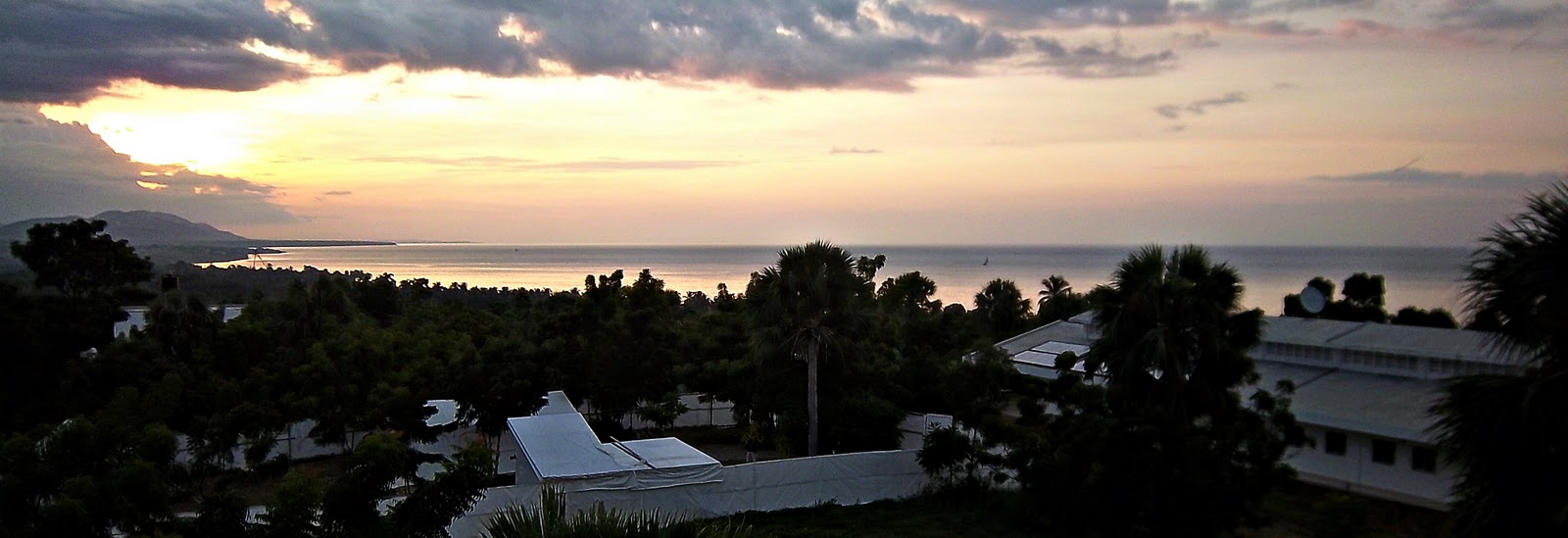
Still there can be unanticipated benefits to having all this.  One is that you can climb up the water tower and get a wonderful view.  In the photo, we see the coastline, campus, clinic, and, expecially, the setting sun.  Almost makes it all worthwhile. 


Thursday, September 15, 2011

Bahama Visitor

One thing we strive to do at Visitation Clinic is to become a model for how rural healthcare should be provided, not just in Haiti but anywhere in the world.  As such, we want the clinic to be the kind of place that is modern, impeccably clean, and the staff is highly competent and compassionate.  But it is hard to know how good a job you really are doing.  After all, most of our patients come from nearby and they don't have a great deal of mobility.  So even when they express gratitude and appreciation, we are never quite sure how we would measure up on the world's stage.  But on occasion we do get some feedback from a traveler who finds himself in the poor, but picturesque, town of Petite Riviere and requires some health care.  Today's email brought such a story from our administrator:

A priest from the Bahamas, Fr. Alain Mary L., attended the clinic while visiting his relatives in Petite Riviere de Nippes. He said that he was very satisfied to the kind of service that he received at the clinic, and particularly to the welcoming and satisfying clinic atmosphere. ''I have never seen and attended a pleasant and clean clinic like this in Haiti'', he said. ''I hope to come back next year and bring some of the Bahamian community to see this marvelous development in PRDN"  

Sunday, September 11, 2011

The Downside of Roadwork


This little fella was in the clinic Thursday for a double whammy.  He is from the nearby town of Charlier where roadwork is underway on a river-crossing bridge.  Well, the road crew cut the water pipe that supplied most of the houses.  After several days of not being repaired, the people had little choice but to revert to taking water directly from the river, which has long been their water source.  Unfortunately, in recent months there has been major change in the river waters of Haiti,  - the cholera bacteria.  So in the past two weeks we have seen a spike in patients coming from Charlier to the Cholera Treatment Unit. 

Carrying Water after the Pipe Was Cut

Most cholera patients recover quickly and return home after a stay of a day or two.  But this boy's mom noticed that even though his cholera symptoms had abated, he was running a fever.  We moved him to the main clinic for tests and found that he also had malaria.


In this photo (taken late in the afternoon after all other patients had gone), our dedicated nurse Ms. Samdie, is explaining to the mother what medications to give our unhappy little patient.  

This whole episode illustrates the big difference a modern clinic can make in people's lives.  Not only were we a location that people knew they could rush to when cholera struck, but we have a staff that responds to unusual or emergency conditions that others would tend to ignore.  Not to mention the fact that we had the lab tests and pharmaceuticals for diagnosing and treating the condition. 

You can help kids like this by donating here
.


Thursday, September 8, 2011

Power to the People

How do you keep a clinic running in Haiti?  Sometimes with old fashioned Haitian ingenuity.   This morning is a case in point.  It started badly, for instead of being greeted with a cup of hot coffee, there was only a message from our administrator - the generator wouldn't start.  I knew instantly that this could be a serious problem.  How so?  First, if it was a simple problem, they would have already fixed it.  Secondly, anything that delays morning coffee is serious.
Dr. Betsy's dental hose put to better use.

We walked out to the generator, hoping the problem was just the starter battery.  But it was able to crank the engine into starting, where upon we we discovered the issue - fuel was dripping from a hose..  Calling a mechanic was an option of course, but it would be a week from Christmas before he got here. 

We had to try to fix it.  I hoped that maybe we could loosen the clamps and just re-secure the hose.  Sure enough, when we started the engine again the fuel was no longer driping - now it was gushing.  Panic.  What to do?  We scoured the clinic looking for a piece of hose..  Killy found some catheters - too small.  Then I remembered the dental compressor.  Surely Dr. Betsy wouldn't miss a 2 inch piece of hose coming from the compressor.  Should I call her and ask permission?  Of course not.  With two snips the hose is harvested and it's back to the generator.  Looks too small we all thought.  But Micheal, our security guard, knew better.  With a lot of pushing and shoving the hose was forced over the fuel line.  Half-hour later, we're all smelling like diesel fuel, but we're done.  The generator cranks, runs, leak is gone. 

Of course, there are alsways side effects.  Every bite of breakfast smells like diesel fuel and what will happen when Dr. Betsy finds out.  But these concerns melt away with a cup of coffee.


Tuesday, September 6, 2011

The Road to Insulin

The cost of providing healthcare in Haiti can be surprisingly high at times.  So we do everything we can think of to reduce expenses.  For instance, road trips are planned to serve as many purposes as possible.  Yesterday was a good example.  Our trip from Port-au-Prince included an airport stop, then a downtown meeting with another NGO, then a rendezvous with our accountant to drop off a tax-check, followed by a stop at a provisioner who had secured some food at a good price, then a quick sandwich which we ate while driving to Leogane to see if we could buy some insulin. 

These days our normal wholesaler is out of insulin more often than not.   So we first stopped at a large hospital to see if they had a good source.  The answer was negative and they explained that they rely on visiting US medical teams to get insulin right now.  After more searching and phone calls, we finally resorted to buying three vials from one pharmacy, and two from another.  The retail price was $18 each.  Not a bad price on the US market, but in Haiti it's more than three-day's pay.  And when you run a clinic where diabetes is not uncommon, and you only charge $1.20 per patient, including exam, lab and meds - it's not hard to see why we work at reducing other expenses. 

During the rest of the drive, I could only reflect on the fact that if you are poor and live in Haiti, it's best not to get diabetes.  If you do, the margin can be very thin between a healthy life and one that is difficult and short.  The margin might just be a 100ml vial, which is located two cities and three paydays away.  Might as well be in Nashville. 

Tuesday, August 30, 2011

How Does the Garden Grow?

Even with  the help of a donated rototiller, gardening can be hard work.  But our team at the clinic emailed this photo with a report that they are in the process of planting a kind of fruit named cassava root or manioc.  They also plan on planting more bananas and sweet potatoes with the hope of reducing the cost of some market days."

Farming is a very labor intensive task in Haiti.  It's mostly done by hand, without the aid of mechanical devices like this tiller.  

Wednesday, August 24, 2011

Cholera Endures

For the last several month we've had the help of a Belgian group in fighting the local cholera outbreak.  Together we've established a Cholera Treatment Unit (UTC) in tents on our campus.  The results have been remarkable and every patient who has made to the clinic has recovered.   Furthermore, the overall number of new cases has declined dramatically. 

Unfortunately, once introduced, cholera isn't easily eradicated.  For instance, today's email brought this news and photos from our administrator: "yesterday the UTC at the clinic has received 5 cholera patients as you can see in the attached. There was a good break, but it seems that it's coming back. 4 come from Cholette and one not far from the clinic.
The Coordinator reported to us that the situation is worst in Miragoane somewhere named Berkin next to the lack where the people do not have clean water."

It is also unfortunate that our Belgian friends' involvement is quite temporary, and in two months they are planning on withdrawing from our area.  So we have to decide whether we can afford to run the UTC by ourselves.  Resources being limited, this will be a difficult decision to make


Sunday, July 17, 2011

Second visiting team


This past week and this upcoming week we have a new team of medical volunteers working at the clinic.  Lead by Dr. Thomas C. who is an MD with over twenty years of experience in internal medicine.  He is accompanied by his son who is currently in medical school. 

We are extremely fortunate to have our visitors these two weeks.  Our clinic often sees over 80 patients a day and it would have been very difficult for our intern, Dr. Delva, to handle this while our Dr. JF is on vacation.  But Dr. Tom has been able to jump in and treat over 40 patients on most days.   

Wednesday, July 6, 2011

Indiana Group at Clinic

This week we have the priviledge of welcoming a group of five medical professionals from Indiana.  They have generously volunteered to work at  the clinic while some of our staff are on vacation.  So far this week they have treated over 80 patients on some days.  Here are a couple photos showing their work this week.

Saturday, July 2, 2011

More road news

In contrast to the previous post, this past week has been bright and sunny and the news we've just received has been the same.  Perhaps it can only be appreciated if we recount the series of events that lead up to it.   The story began almost a year ago at a Nashville fund raiser.  During the post-event clean up, a chance conversation began with one of our dedicated volunteers.  The topic was the need for a better access road at our clinic.  But, unlike previous conversations on this topic, this time it took a surprising turn.  Our volunteer offered to contact a friend who was a manager at Caterpillar.  The manager, in turn, enthusiastically offered to contact a Cat associate in the Caribbean.  This man made it his mission to talk to the Cat dealer in Haiti, who by email offered to help us.  We met with this gentleman earlier this year and he offered to contact a close friend who was building a road near our clinic.   This past week, all of this calling and emailing payed off.  As the photo shows, there is now a large crew and several machines working on our road.  The local mayor has even assisted by contacting local property owners so that they know about the work. 

At times people wonder how they can make a difference in Haiti.  The marvelous lesson in this story is that sometimes all it takes is a simple phone call or email to a friend.


Friday, July 1, 2011

Rainy Weather


Visitation Clinic is located a quarter-mile up the mountain from the main road.  Our only access is by a dirt road which gets soft and slick when it rains.  During the rainy season (which just ended), our road gets quite muddy.  And here we are using the term "muddy" in the Haitian context - meaning that off-road 4x4's get so bogged down that it litterally takes a dozen men and a boy to get it unstuck.  (See photo)

This can be a serious problem for a busy clinic like ours.  In fact, the reason that our driver attempted to drive the road on the day of the photo was for a patient diagnosed with acute apendicits.  Fortunately, our volunteer road crew prevailed and were able to extract our SUV and get our patient to surgery.  Still, this episode again demonstrated the importance of decent roads in Haiti. 

Tuesday, June 21, 2011

Education is Essential


One of the ways that we are improving overall health is through education programs for the community.  Here is a photo of Dr. JF and some of the attendees of a recent seminar titled "Diabetiis and Your Feet".  The presentation used our new vidoe projector and a powerpoint presentation in Creole.  According to our administrator Killy, the presentations gave pointers on how to care for feet and toes, how walk with care, what kind of shoes to wear and so forth.  Of the twenty attendees, fifteen were diabetic patients.

Tuesday, May 10, 2011

Visitation Clinic subject of recent news article.

Three-year-old rural clinic focuses on compassion in care
 
By Dennis Sadowski Catholic News Service

PETITE-RIVIERE-DE-NIPPES, Haiti (CNS) -- Beyond a few hospitals, quality health care facilities in Haiti are scarce. It's the clinics -- some big, some small -- that provide the bulk of health care Haitians receive.

One such clinic is located 70 miles west of the capital, Port-au-Prince, in the rural community of Petite-Riviere-de-Nippes. The three-year-old Visitation Clinic -- a project of the Visitation Hospital Foundation in Nashville, Tenn. -- sees about 70 patients a day. Most have common illnesses -- gastro-intestinal ailments, urinary tract infections or a slight infection, all typically caused by ingesting contaminated water.

In a country where access to health care is limited, having a clinic nearby can mean the difference between a mild illness or something more serious.

Many patients are children whose parents are glad the clinic opened in their seafront town because it saves them from making the 45-minute, 10-mile trip over sometimes rocky unpaved roads to St. Therese Hospital in Miragoane.

Dr. Rony Jean-Francois has worked at the clinic since it opened in 2008. He left a hospital in Port-au-Prince to work among people who have few other alternatives for care.

"I'm proud of my work because I'm giving service. It's a gift to be part of it. I can bring my competence to a community that is by itself without help," the 43-year-old physician said.

Since January, the clinic has housed a cholera treatment unit on its grounds. At the peak of the epidemic in December and January, the unit's 30 beds were nearly full for days on end.

Jean-Francois and the clinic's administrator, Riphard "Killy" Serent, made the rounds to the 30,000 residents in town and the surrounding rural area for weeks, talking about cholera prevention techniques: proper hygiene, including regular hand washing, and drinking only safe water. Serent said the effort likely prevented the clinic from being overwhelmed with cholera cases.

Through April 19, more than 200 people had been treated at the clinic and in the special unit opened by Doctors of the World, a French medical aid agency, on the clinic grounds.

Haiti's health care system was severely tested with the cholera outbreak. Through April 12, Haiti's Ministry of Health and Population reported more than 283,000 cholera cases with more than 4,800 deaths.

Until October, Haiti had not seen a reported case of cholera for 50 years. The disease unexpectedly reappeared in rural Artibonite department in the center of the country, and the strain was traced to South Asia.

At Visitation Clinic, while cholera was not as serious a challenge as elsewhere, Jean-Francois and Serent still face daily challenges because of the deep poverty in which people live. Most patients arrive on foot, some leaving home before dawn so that they arrive for the clinic's early morning opening.

Numerous patients over two days said they found the staff helped them feel respected and comfortable.

That falls in line with the clinic's mission to provide "competent and compassionate health care."

Jean-Francois sees the clinic's work simply.

"The foundation of the clinic is love," he said. "Everybody is involved in it."

Monday, May 2, 2011

Don't know how they did it


Our first pediactric dental mission was an unqualified success.  Somehow, nearly everyday Betsy and Stacy worked, they were able to see more patients than the previous day.   In eight working days, they treated 154 patients - 29 children under 7 yrs, 117 children from 7 to 18 yrs, and even eight adults.  To accomplish this they worked from the clinic's opening  until well after dark.  They even arranged for hourly announcements on the local radio station so that parents would know this service was available. 

One would think they would be exhausted.  But Betsy emailed this morning.  She is trying to figure out how to add a second dental chair to speed things up.   She's getting estimates to fully equip a dental clinic.  She's even trying to figure out how to rewire the clinic so that the lights don't dim when the compressor comes on.  She's hoping to return soon.

Our gratitude to Betsy, Stacy and Johnson is immense.  And we all now realize the tremendous need for dental healthcare and education for the chilcren in rural Haiti.