Donate

We need your help - DONATE HERE
Want to learn more? Go HERE

Tuesday, August 30, 2011

How Does the Garden Grow?

Even with  the help of a donated rototiller, gardening can be hard work.  But our team at the clinic emailed this photo with a report that they are in the process of planting a kind of fruit named cassava root or manioc.  They also plan on planting more bananas and sweet potatoes with the hope of reducing the cost of some market days."

Farming is a very labor intensive task in Haiti.  It's mostly done by hand, without the aid of mechanical devices like this tiller.  

Wednesday, August 24, 2011

Cholera Endures

For the last several month we've had the help of a Belgian group in fighting the local cholera outbreak.  Together we've established a Cholera Treatment Unit (UTC) in tents on our campus.  The results have been remarkable and every patient who has made to the clinic has recovered.   Furthermore, the overall number of new cases has declined dramatically. 

Unfortunately, once introduced, cholera isn't easily eradicated.  For instance, today's email brought this news and photos from our administrator: "yesterday the UTC at the clinic has received 5 cholera patients as you can see in the attached. There was a good break, but it seems that it's coming back. 4 come from Cholette and one not far from the clinic.
The Coordinator reported to us that the situation is worst in Miragoane somewhere named Berkin next to the lack where the people do not have clean water."

It is also unfortunate that our Belgian friends' involvement is quite temporary, and in two months they are planning on withdrawing from our area.  So we have to decide whether we can afford to run the UTC by ourselves.  Resources being limited, this will be a difficult decision to make. 


Sunday, July 17, 2011

Second visiting team


This past week and this upcoming week we have a new team of medical volunteers working at the clinic.  Lead by Dr. Thomas C. who is an MD with over twenty years of experience in internal medicine.  He is accompanied by his son who is currently in medical school. 

We are extremely fortunate to have our visitors these two weeks.  Our clinic often sees over 80 patients a day and it would have been very difficult for our intern, Dr. Delva, to handle this while our Dr. JF is on vacation.  But Dr. Tom has been able to jump in and treat over 40 patients on most days.   

Wednesday, July 6, 2011

Indiana Group at Clinic

This week we have the priviledge of welcoming a group of five medical professionals from Indiana.  They have generously volunteered to work at  the clinic while some of our staff are on vacation.  So far this week they have treated over 80 patients on some days.  Here are a couple photos showing their work this week.

Saturday, July 2, 2011

More road news

In contrast to the previous post, this past week has been bright and sunny and the news we've just received has been the same.  Perhaps it can only be appreciated if we recount the series of events that lead up to it.   The story began almost a year ago at a Nashville fund raiser.  During the post-event clean up, a chance conversation began with one of our dedicated volunteers.  The topic was the need for a better access road at our clinic.  But, unlike previous conversations on this topic, this time it took a surprising turn.  Our volunteer offered to contact a friend who was a manager at Caterpillar.  The manager, in turn, enthusiastically offered to contact a Cat associate in the Caribbean.  This man made it his mission to talk to the Cat dealer in Haiti, who by email offered to help us.  We met with this gentleman earlier this year and he offered to contact a close friend who was building a road near our clinic.   This past week, all of this calling and emailing payed off.  As the photo shows, there is now a large crew and several machines working on our road.  The local mayor has even assisted by contacting local property owners so that they know about the work. 

At times people wonder how they can make a difference in Haiti.  The marvelous lesson in this story is that sometimes all it takes is a simple phone call or email to a friend.


Friday, July 1, 2011

Rainy Weather


Visitation Clinic is located a quarter-mile up the mountain from the main road.  Our only access is by a dirt road which gets soft and slick when it rains.  During the rainy season (which just ended), our road gets quite muddy.  And here we are using the term "muddy" in the Haitian context - meaning that off-road 4x4's get so bogged down that it litterally takes a dozen men and a boy to get it unstuck.  (See photo)

This can be a serious problem for a busy clinic like ours.  In fact, the reason that our driver attempted to drive the road on the day of the photo was for a patient diagnosed with acute apendicits.  Fortunately, our volunteer road crew prevailed and were able to extract our SUV and get our patient to surgery.  Still, this episode again demonstrated the importance of decent roads in Haiti. 

Tuesday, June 21, 2011

Education is Essential


One of the ways that we are improving overall health is through education programs for the community.  Here is a photo of Dr. JF and some of the attendees of a recent seminar titled "Diabetiis and Your Feet".  The presentation used our new vidoe projector and a powerpoint presentation in Creole.  According to our administrator Killy, the presentations gave pointers on how to care for feet and toes, how walk with care, what kind of shoes to wear and so forth.  Of the twenty attendees, fifteen were diabetic patients.

Tuesday, May 10, 2011

Visitation Clinic subject of recent news article.

Three-year-old rural clinic focuses on compassion in care
 
By Dennis Sadowski Catholic News Service

PETITE-RIVIERE-DE-NIPPES, Haiti (CNS) -- Beyond a few hospitals, quality health care facilities in Haiti are scarce. It's the clinics -- some big, some small -- that provide the bulk of health care Haitians receive.

One such clinic is located 70 miles west of the capital, Port-au-Prince, in the rural community of Petite-Riviere-de-Nippes. The three-year-old Visitation Clinic -- a project of the Visitation Hospital Foundation in Nashville, Tenn. -- sees about 70 patients a day. Most have common illnesses -- gastro-intestinal ailments, urinary tract infections or a slight infection, all typically caused by ingesting contaminated water.

In a country where access to health care is limited, having a clinic nearby can mean the difference between a mild illness or something more serious.

Many patients are children whose parents are glad the clinic opened in their seafront town because it saves them from making the 45-minute, 10-mile trip over sometimes rocky unpaved roads to St. Therese Hospital in Miragoane.

Dr. Rony Jean-Francois has worked at the clinic since it opened in 2008. He left a hospital in Port-au-Prince to work among people who have few other alternatives for care.

"I'm proud of my work because I'm giving service. It's a gift to be part of it. I can bring my competence to a community that is by itself without help," the 43-year-old physician said.

Since January, the clinic has housed a cholera treatment unit on its grounds. At the peak of the epidemic in December and January, the unit's 30 beds were nearly full for days on end.

Jean-Francois and the clinic's administrator, Riphard "Killy" Serent, made the rounds to the 30,000 residents in town and the surrounding rural area for weeks, talking about cholera prevention techniques: proper hygiene, including regular hand washing, and drinking only safe water. Serent said the effort likely prevented the clinic from being overwhelmed with cholera cases.

Through April 19, more than 200 people had been treated at the clinic and in the special unit opened by Doctors of the World, a French medical aid agency, on the clinic grounds.

Haiti's health care system was severely tested with the cholera outbreak. Through April 12, Haiti's Ministry of Health and Population reported more than 283,000 cholera cases with more than 4,800 deaths.

Until October, Haiti had not seen a reported case of cholera for 50 years. The disease unexpectedly reappeared in rural Artibonite department in the center of the country, and the strain was traced to South Asia.

At Visitation Clinic, while cholera was not as serious a challenge as elsewhere, Jean-Francois and Serent still face daily challenges because of the deep poverty in which people live. Most patients arrive on foot, some leaving home before dawn so that they arrive for the clinic's early morning opening.

Numerous patients over two days said they found the staff helped them feel respected and comfortable.

That falls in line with the clinic's mission to provide "competent and compassionate health care."

Jean-Francois sees the clinic's work simply.

"The foundation of the clinic is love," he said. "Everybody is involved in it."

Monday, May 2, 2011

Don't know how they did it


Our first pediactric dental mission was an unqualified success.  Somehow, nearly everyday Betsy and Stacy worked, they were able to see more patients than the previous day.   In eight working days, they treated 154 patients - 29 children under 7 yrs, 117 children from 7 to 18 yrs, and even eight adults.  To accomplish this they worked from the clinic's opening  until well after dark.  They even arranged for hourly announcements on the local radio station so that parents would know this service was available. 

One would think they would be exhausted.  But Betsy emailed this morning.  She is trying to figure out how to add a second dental chair to speed things up.   She's getting estimates to fully equip a dental clinic.  She's even trying to figure out how to rewire the clinic so that the lights don't dim when the compressor comes on.  She's hoping to return soon.

Our gratitude to Betsy, Stacy and Johnson is immense.  And we all now realize the tremendous need for dental healthcare and education for the chilcren in rural Haiti.


Thursday, April 28, 2011

Watchin'

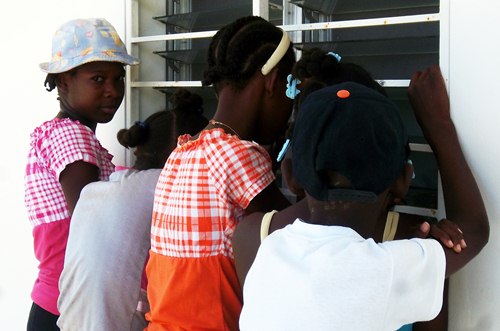
Our dental team has treated 121 patients as of yesterday, and somehow they are able to see more each day.  Yesterday they saw 30 children, nine of whom were under six years old.  As seen here, there is often an audience of very interested children at the window who seem riveted by watching our dental team at work.  Dr. Betsy encourages this.  She hopes the onlookers today will become the future dentists of Haiti.  We also want to note that the newest member of the Unit is Mr. Johnson (left).  He is an interpreter who lives in Petite Riviere when he is not in school.  He has become our dental health advocate who explains to the children the technique and importance of taking care of their teeth.

Wednesday, April 27, 2011

Waitin'

 
Waiting for the dentist
 
Waiting some more


\

Still waiting


Monday, April 25, 2011

Redemption songs


\

Rural Haitians have little exposure to video media.   Televisions are scarce, theatres are rare, and even the viewing of DVDs is limited.  What takes their place are the churches.  Even a small town like Petite Riviere can have a grand church that holds a large congregation, some of whom will walk considerable distances to attend.  Non-Haitian visitors to rural churches are infrequent, but those few who are fortunate to attend will invariably experience an unforgettable celebration.  Perhaps most striking is the music.  Even on Sundays in ordinary time, the celebrations will seldom last less than two hours and the musical bounty that enfolds a visitor seems to endure and refresh for days.  The entire congregation is the choir and all will sway and pray, both individually and communally in harmony to the music.  The instrumental accompaniment is just as diverse and infectious.  Drums, of course, are prominent and essential.   
This past Sunday was Easter and the ceremony was undoubtedly the most spectacular of the year.  But even the days preceding Easter have their own beauty.  For instance, the music and lower photo here came from the more reflective celebration on Holy Thursday. 
This past year, the world has noted the tremendous resilience and hope that Haitians retain, even in the most trying of times.  One cannot help but wonder if it is Haiti's music and celebrations that nourish this most precious of virtues. 

Saturday, April 23, 2011

The Unit

There is a television series called "The Unit" which is about a team of specially recruited, highly trained, disciplined and dedicated soldiers who work in difficult circumstances to accomplish their mission.  I dream that the producers will travel to rural Haiti someday and see the real thing at work.  We have a number of Units at Visitation Clinic.  Our newest one is lead by Dr. Betsy Barcroft from Memphis who is an accomplished pediatric dentist and spends her free time treating disadvantaged children to places like Alaska, Hopi Indian reservations, rural Arkansas and now Haiti.  She and her incredibly efficient assistant Stacy have volunteered for ten days to work at our clinic with the goal of seeing every child they possibly can.  Each day, they start early, don't want to take lunch breaks and work until the last child is seen.  They spent weeks preparing for the trip, acquiring all the equipment, supplies and instruments, which they squeezed into their checked baggage.  Betsy even did her own fundraising for the project.  

It is unfortunate that our Unit's members share a major flaw which will keep them from becoming television action heroes.  They are just too darn nice to be believable and the children actually like them.


Wednesday, April 20, 2011

The worst of times, the best of times

Imagine for a moment that you are a child in rural Haiti and your tooth hurts.  Next thing you know your parents are taking you to a big white building where maybe you can hear some kid crying through one of the windows.  Then after waiting for a long time, your mom takes you to a  room filled with scary stuff, where these pale strangers put you into a weird chair that nearly turns you upside down, then they get out the biggest needle you've ever seen, even though they try to hide it, and then it feels like a couple stings and your mouth feels thick and funny.  Next thing they are cramming  weird gadgets that look like scissors into your mouth, then a loud machine makes this noise and there is a whining sound on that tooth that you don't want anyone touching.  And you can't even holler to your mom who is sitting next you looking worried.  Finally after a fistful of forevers they are taking the stuff out of your mouth and you can't stop shaking and you want to cry except it seems too late.  But then the strangest thing happens.  You get this little car like you've never seen before with wheels that actually turn and it's the most wonderful thing and you can't wait to get outside to play with it.  And somehow you can't quite remember how the worst day of your life turned into one of the best.

Click here and you help change a child's day at Visitation Clinic in Haiti.


Tuesday, April 19, 2011

Dental screening

This week we are bringing a new program to Petite Riviere - pediatric denistry.  We have two dedicated volunteers with years of experience in chilren's denistry.  Today they were screening children in a nearby school.  The video shows how this was done.  Unfortunately our team found that nearly all of the older children had untreated cavities and other dental problems.  In fact, it looked like most of children had no prior dental care.  Over the next ten days, our team will be treating these children and, we hope, many others too.  Our team won't be pulling many teeth.  They have come with all the equipment and materials to do high quality restorative dentistry.
If you are very observant, you can see on the blackboard a table showing the size of the class.  For those of you who can't quite make it out, the sign shows that there are 83 children in this modest sized class room. 

Saturday, April 9, 2011

Market

In rural Haiti there are no supermarkets, convenience stores, or Walmarts.  Shopping and trading is done in an open market that lines the main street of Petite Riviere every Wednesday. 
The daily diet of most rural Haitians consists of rice, beans, fruit and grain products.  With no electricity, there are few refrigerators and ice is a rarity.  So storing meats and fish is a challenge. 

The lack of refrigerators also impacts the healthcare that Visitation Clinic provides.  We can't dispense pharmauciticals that require temperature controls.  And patients with trauma injuries can't apply ice to reduce swelling.

Saturday, April 2, 2011

Education

One of VHF's core missions is to provide health education to the general populace.  We do this in a variety of ways, including radio talk shows, large public gatherings and, every morning, a meeting with the patients.  These photos show typcial morning meetings.  The patients have gathered in the clinic's shaded portico and are waiting for the clinic to open.  Each day, one of our medical staff has been assigned the task of preparing a short talk on some public health issue.  This can range from basic hygiene, to child nuitrition, to the need to take medicines in the proper manner.  When Dr. JF is the presenter, there is often much humor in the presentation and much laughter and smiles in the audience.  Programs like this can be one of the most effective ways to improve overall health, as well as to quickly get on top of outbreaks of diseases like cholera.

Monday, March 28, 2011

Artists

One wonders at times if there is a more naturally artistic people than Haitians.  From the infectious music, to the elaborate painting of the private buses or "tap-taps" one can hardly avoid encountering artisans.  Even in rural areas like Petite Riviere, one can encounter art in surprising ways, including the elaborate embroidery of children's homemade dresses and the painting of fishing boats. 
Still, we were surprised on our recent trip to find this elaborate mural on the walls of a new gathering-spot that is being built.  The artist is a local resident who appears to have not just exceptional skill but a great deal of practice and training.   

Friday, March 25, 2011

Homes of Petite Riviere

People wonder about where our patients live and what a typical home looks like.  Here are two that sit on the beach.  Houses are made of either wood or cement block with a metal roof.  They are about the size of the utility sheds that are sold at places like Home Depot or Lowes.  If the family is very poor, the floor will be dirt and the roof might be banana fronds.  More common will be a concrete floor.  Cooking is done outside the house, usually on the ground and over charcoal.  Indoor plumbing is very rare.  There is no electricity, of course.  Glass windows are only for the rich.  As are window screens.
 
These homes sit right at the sea's edge and in good weather the view is very beautiful.  But, as everyone knows too well, Haiti is prone to earthquakes, tropical storms and huricanes.  Houses like these are not where you would want to be in any of these.